Syllabus
Wed & Fri, 1:00-2:20pm, on Zoom, 3 credits
Instructor: Kaveh Rafie
Contact: KRafie@nwpolytech.ca
Office Hours: Wednesday 2:30-4:00pm
Description
Section titled “Description”The course adopts a global perspective, examining art from prehistory through to the 15th century. It is not an exhaustive survey but focuses on major developments in art through case studies from past cultures and communities in diverse global regions. These case studies enable the exploration of examples from both non-Western and Western traditions. The course aims to enhance understanding and appreciation of visual art and art history methodologies, providing students with a foundational knowledge of art history and its pivotal moments.
Prerequisite(s)/Corequisite:
Section titled “Prerequisite(s)/Corequisite:”None
Delivery Mode
Section titled “Delivery Mode”Online (via Zoom) at link-to-zoom-meeting.com
Learning Outcomes
Section titled “Learning Outcomes”- Analyze works of art from across the globe by examining their formal qualities, historical context, and cultural meaning.
- Identify key monuments and objects from global art history, from prehistory to the 15th century.
- Compare and contrast artistic works from different periods, movements, and cultures.
- Interpret art objects using primary and secondary sources to construct evidence-based arguments.
- Articulate ideas clearly through both written assignments (employing the basics of art historical writing) and informed discussion.
- TODO How to actively read / annotate
In particular, we will emphasize these: Critical thinking (capacity to integrate diverse views into a single analytically rigorous and factually-grounded judgment) Creativity (capacity to solve problems when obvious solutions are not available) Visual literacy (capacity to makeover sense of the many, often contradictory meanings of visual expression)
Transferability important
Section titled “Transferability ”Please consult the Alberta Transfer Guide for more information. You may check to ensure the transferability of this course at the Alberta Transfer Guide main page http://www.transferalberta.alberta.ca.
Required Texts
Section titled “Required Texts”This course does NOT require a textbook. All readings are provided via the course LMS and Perusall. They are divided into two types:
- Core Readings: These readings, primarily from Smarthistory, provide the essential historical context and overview for the week’s topics.
- Analytical Readings (on Perusall): These are scholarly texts that make a specific argument. Your task is not just to read them, but to annotate them actively on Perusall—questioning the author’s thesis, analyzing their evidence, and connecting ideas. This practice is central to art historical research. See the Evaluation section for details.
Bahrani, Zainab; 2017. Art of Mesopotamia. Thames & Hudson. Nelson, R. and R. Shiff (eds.) Critical Terms for Art History. Chicago: Chicago University Press. Pedley, John Griffiths; 2002. Greek Art and Archaeology. New Jersey: Prentice Hall. Preziosi, D. and L. Hitchcock; 2000. Aegean Art and Architecture. Oxford History of Art. Robins, Gay; 2008. The Art of Ancient Egypt. (Revised Edition). Harvard University Press. Ramage, Nancy H. and Andrew Ramage; 1991. Roman Art. New Jersey: Prentice Hall. Zanker, Paul; 2008. Roman Art. Trans. H. Heitmann-Gordon. Los Angeles: The J. Paul Getty Museum.
Anne D’Alleva,
Course Format
Section titled “Course Format”The course will be delivered online via Zoom, with synchronous class sessions held weekly. Students are expected to attend these sessions, engage with the course materials, read the assigned texts, participate in discussions, and complete assignments on time.
Use the following link to connect to the Zoom meeting: link-to-zoom-meeting.com
Art Historical Analysis
Section titled “Art Historical Analysis”There are many approaches to art historical understanding but for our purposes we will focus on four:
- Formal analysis (color, shape, texture, scale, line, shadow, space, composition and other physical properties of the work itself)
- Iconographic analysis (story, theme or subject presented by the work including any symbolism or veiled meanings that would be legible to people part of the artist’s culture)
- Sociohistorical analysis (social, political, economic and cultural context in which the work is produced)
- Aesthetic analysis (sensuous and psychological impact that the work has on you and others)
Evaluation
Section titled “Evaluation”Your grade in this course will be based on the following components:
Participation & Attendance
Reading Annotations
Artifacts
Comparative Analysis
Ancient World in Contemporary Visual Culture
Detailed guidelines for each component will be provided in the course LMS.
1) Participation & Attendance
Section titled “1) Participation & Attendance”Active participation is crucial for this course. Your grade is based on the following components:
- Consistent Engagement: You are expected to keep your camera on during live Zoom sessions to foster a collaborative learning environment. (Cameras may be off during breaks).
- Discussion Contribution: Actively contribute to class discussions by asking questions, responding to prompts, and engaging with your peers’ ideas.
- In-Class Activities: Complete all micro-activities, such as polls and short collaborative tasks, announced during the session.
Attendance Policy: Attendance for our live Zoom sessions is mandatory. More than two unexcused absences will require a meeting with the instructor to discuss your standing in the course. Failure to address chronic absenteeism may result in not passing the course.
If you have high levels of social anxiety or find it challenging to read social cues in a groups discussion, and find yourself unable but eager to participate please email me at AMilcic@nwpolytech.ca: we can discuss alternatives or how to manage anxiety around participation.
Note on Recordings: Sessions will be recorded for educational purposes. By participating, you consent to being recorded. If you miss a session, please email me to receive the link of the missed session.
2) Reading Annotations
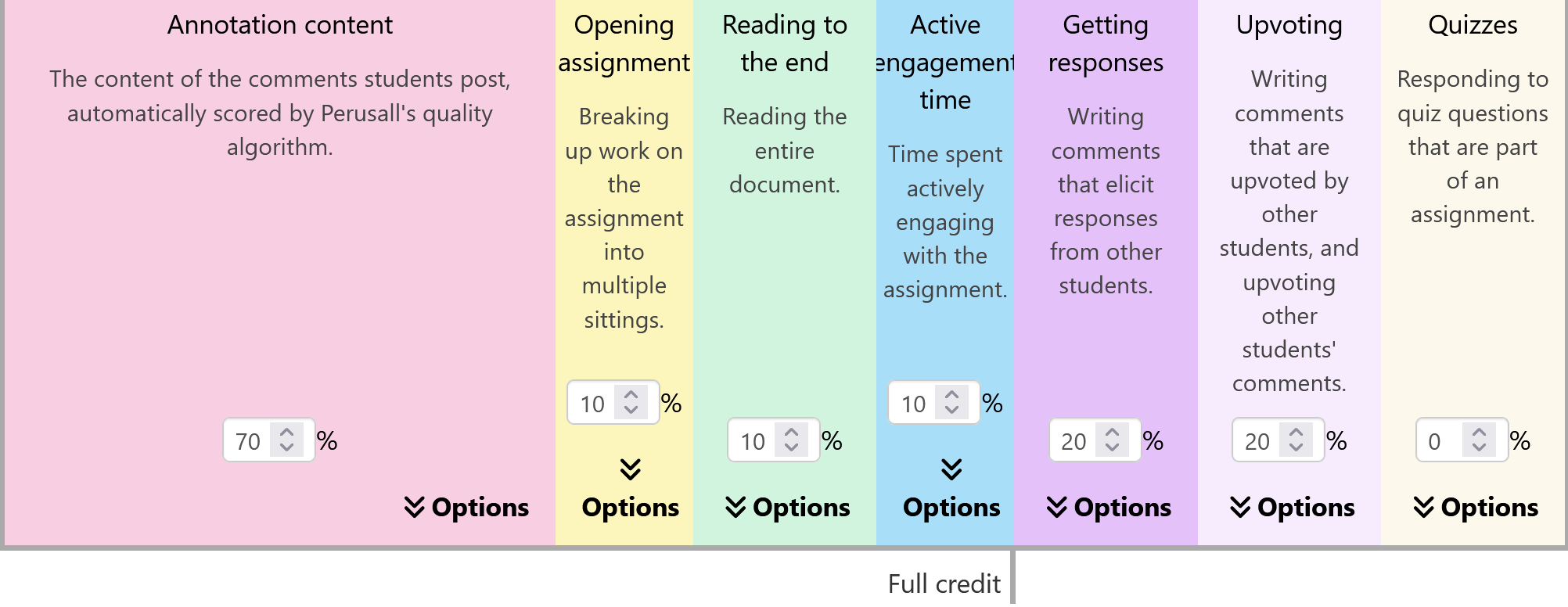
Section titled “2) Reading Annotations”Reading assignments will be completed on Perusall. Your grade will be based on the quality of your annotations, which will be evaluated according to the criteria in the chart below
3) Artifacts
Section titled “3) Artifacts”Artifacts are creative projects that allow you to engage with course materials beyond traditional writing. While rooted in research and critical thinking, they encourage artistic expression and alternative modes of understanding.
You may respond to prompts through various mediums (e.g., visual art, creative writing, or digital media)—to demonstrate your insights.
Please check the LMS and course announcements for specific prompts and detailed guidelines for each assignment.
4) Comparative Analysis
Section titled “4) Comparative Analysis”This is a traditional essay assignment where you will compare two artworks from different cultures or time periods discussed in the course. The essay should demonstrate your ability to analyze formal qualities, historical context, and cultural significance (See Art Historical Analysis).
The analysis will be around 500-750 words.
5) Ancient World in Contemporary Visual Culture
Section titled “5) Ancient World in Contemporary Visual Culture”This assignment asks you to trace the influence of ancient art on contemporary visual culture. You will find a modern work that draws from ancient themes, motifs, or techniques and analyze the connection in a final paper.
Part 1: Proposal (5%)
Section titled “Part 1: Proposal (5%)”Length: 150-200 words
Task: Identify a modern film, book, advertisement, artwork, or other media (including your own creative work). Briefly explain its connection to an ancient source or a theme from our course.
Part 2: Final Paper (30%)
Section titled “Part 2: Final Paper (30%)”Length: 1000-1250 words
Task: Write a detailed analysis of your chosen contemporary work. Explore how it reinterprets, references, or draws inspiration from the ancient art or themes we have studied.
Suggested Starting Point
Section titled “Suggested Starting Point”Grading Scale
Section titled “Grading Scale”| Alpha Grade | 4-point Equivalent | Percentage Guidelines |
|---|---|---|
| A+ | 4.0 | 95-100 |
| A | 4.0 | 85-94 |
| A- | 3.7 | 80-84 |
| B+ | 3.3 | 77-79 |
| B | 3.0 | 73-76 |
| B- | 2.7 | 70-72 |
| C+ | 2.3 | 67-69 |
| C | 2.0 | 63-66 |
| C- | 1.7 | 60-62 |
| D+ | 1.3 | 55-59 |
| D | 1.0 | 50-54 |
| F | 0.0 | 00-49 |
Student Responsibilities
Section titled “Student Responsibilities”• On-line Communication & Professionalism: Students are expected to maintain a high-level of professionalism across all course-related communications. Please conduct your communications as you would any other professional experience. Treat your colleagues with respect! • Join the lecture to on time and remain for duration of class and related activities. • Students can expect to put in a minimum of 4 hours per week on out-of- class work. Assignments will be expected on the date required.
Academic Integrity
Section titled “Academic Integrity”All students are expected to uphold the highest standards of academic integrity. This means that you must complete your own work and give proper credit to the ideas and work of others. Any form of academic dishonesty, including plagiarism, will not be tolerated and may result in disciplinary action.
For a more precise definition of academic misconduct and its consequences, refer to the Student Rights and Responsibilities policy available at https://www.nwpolytech.ca/about/administration/policies/index.html.
Note: All Academic and Administrative policies are available on the same page.
The Regulation Regarding the Use of AI Tools
Section titled “The Regulation Regarding the Use of AI Tools”The use of AI can be useful as for brainstorming or getting feedback about your writing but consider these:
- AI can demonstrate biases and inaccuracies at times. Always validate the content before accepting it.
- Be cautious with data privacy. Don’t input anything too personal or private. You can’t control where it ends up. If you wouldn’t post it on the internet, don’t give it to an AI.
- Recognize the limitations. AI doesn’t truly comprehend facts or meaning yet. It makes guesses, which means it can confidently provide false information. AI content may initially seem impressive, but usually is not as good as you think it is. I call these AI goggles. Take care whenever using AI-generated text.
This course prohibits the use of AI tools without proper acknowledgement of AI use. By AI means LLMs. The student must identify the capacity that AI used and writing with AI is strongly prohibited. But student can use AI to improve grammar and clarity of writing. To use in this capacity the student must acknowledge the use and the way it used. You will ask to fill AI use declaration form for each assignment to be considered for grading.
Comparative Analysis Ancient World in Contemporary Visual Culture
Taught at